Power Inductor Manufacturer
Reliable inductors for power conversion, energy storage and current regulation.
Conversion
Storage
Regulation
Applications
Magno Teknik manufactures power inductors for power conversion, energy storage, current regulation, and filtering applications. Our power inductor range includes SMD, shielded, high-current, drum-core, and other constructions designed for different electrical, thermal, and mechanical requirements. Engineers can select a suitable power inductor based on inductance, tolerance, saturation current, RMS current, DCR, operating temperature, switching frequency, and package dimensions. This page provides an overview of Magno Teknik power inductors, including their key specifications, applications, selection considerations, and available product options.
Power Inductors for Power Electronics
Power inductors are magnetic components used to store energy, control current, and reduce current ripple in power electronic circuits. They are commonly used in switching regulators, DC-DC converters, LED drivers, power supplies, battery-powered equipment, and filtering applications.
The required inductor characteristics depend on the electrical and mechanical requirements of the circuit. Inductance alone is not sufficient for component selection. Engineers should also evaluate saturation current, RMS or rated current, DCR, temperature rise, operating temperature, frequency characteristics, dimensions, and the manufacturer’s test conditions.
Magno Teknik provides power-inductor solutions for different current levels, package requirements, circuit topologies, and application conditions.
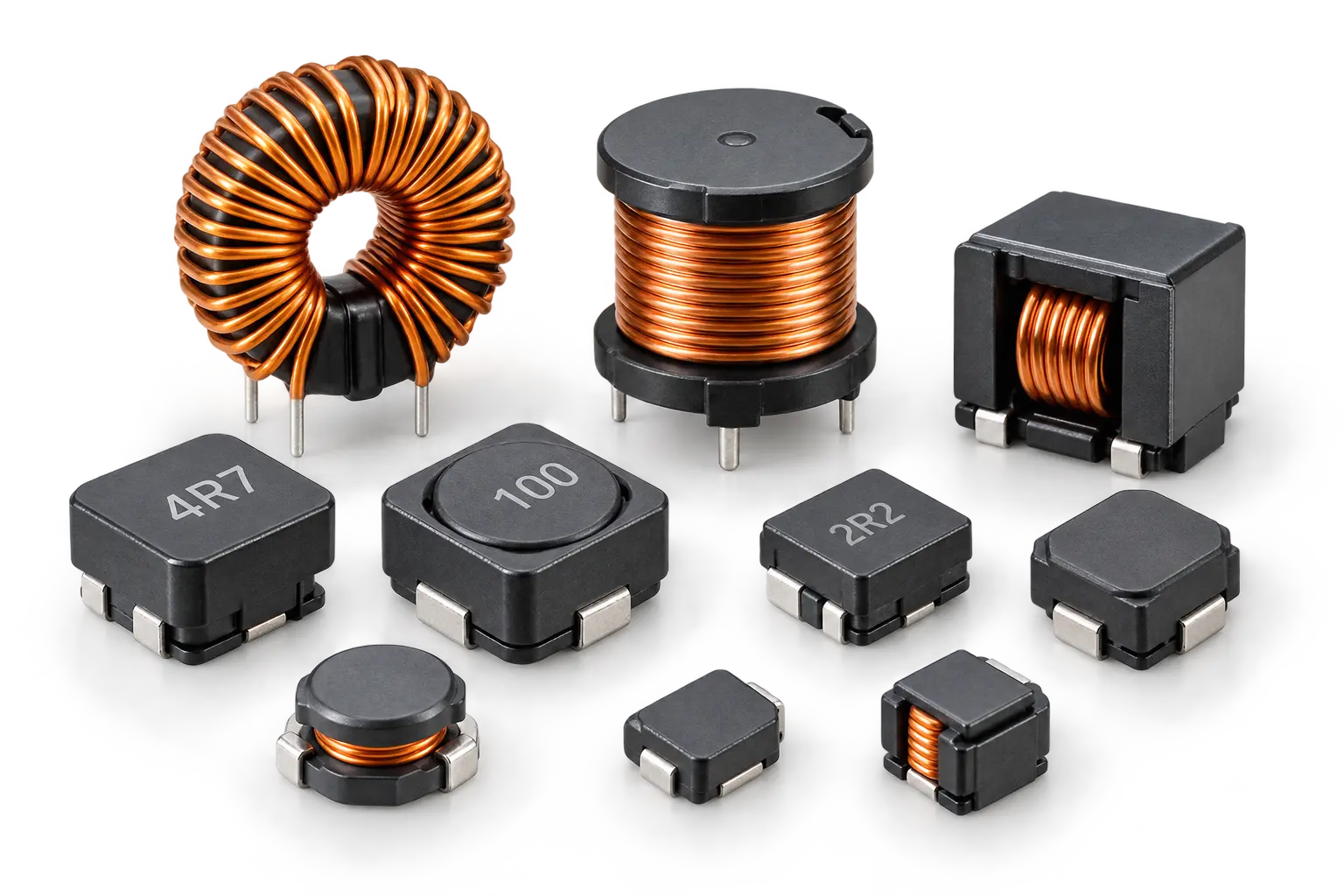
Power Inductor Types
Different power-inductor constructions provide different electrical, magnetic, thermal, and mechanical characteristics. The appropriate construction depends on the circuit design, current level, operating frequency, EMI requirements, and available PCB space.
SMD Power Inductors
SMD power inductors are designed for surface-mount PCB assembly and are commonly used where compact dimensions and automated manufacturing are required.
They can be used in applications such as DC-DC converters, voltage regulators, LED drivers, power supplies, and other switching circuits.
Shielded Power Inductors
Shielded power inductors are constructed to provide greater control of the external magnetic field compared with conventional unshielded constructions. This can be important in compact PCB layouts where magnetic coupling between components needs to be considered.
Selection should still be based on inductance, current, DCR, temperature rise, frequency, package dimensions, and the actual circuit requirements.
High Current Power Inductors
High-current power inductors are designed for power-conversion applications where the inductor must carry relatively high current while maintaining the required inductance, temperature performance, and electrical stability. They are commonly used in DC-DC converters, voltage regulators, power supplies, LED drivers, and other circuits with significant current demand.
When selecting a high-current power inductor, engineers should consider:
- Saturation current (Isat) — determines how much current the inductor can handle before its inductance decreases significantly.
- RMS or rated current — indicates the current level associated with the specified thermal or temperature-rise limit.
- DCR — affects copper loss and contributes to power dissipation and temperature rise.
- Inductance under DC bias — shows how the inductance changes as operating current increases.
- Temperature rise — helps determine thermal performance under continuous operation.
- Operating temperature — defines the allowable environmental and component temperature range.
- Package dimensions — must meet the PCB space, height, and mechanical requirements of the application.
Drum Core Inductors
Drum core inductors use a drum-shaped magnetic core with a winding around the core structure. They are used in power conversion, filtering, energy-storage, and other electronic circuits.
The required component should be selected according to inductance, current capability, DCR, saturation characteristics, frequency, temperature, and mounting requirements.
Toroidal Power Inductors
Toroidal power inductors use a ring-shaped magnetic core with the winding distributed around the magnetic path. Their construction provides a closed magnetic circuit, which can influence external magnetic-field behavior.
The selection of a toroidal inductor depends on inductance, current, core characteristics, winding resistance, temperature rise, frequency, and mechanical requirements.
Power Inductor Specifications
| Specification | Why It Matters |
|---|---|
| Inductance | Determines the inductor’s response to current change and energy storage |
| Inductance Tolerance | Defines the allowable variation from the nominal value |
| Saturation Current (Isat) | Indicates the current associated with a specified reduction in inductance |
| RMS / Rated Current | Indicates current capability under specified thermal conditions |
| DCR | Determines winding-related DC power loss and voltage drop |
| Temperature Rise | Indicates the increase in component temperature under specified conditions |
| Operating Temperature | Defines the permitted component temperature range |
| DC Bias | Shows how inductance changes as DC current increases |
| Switching Frequency | Affects core loss, winding loss, impedance, and component performance |
| Dimensions | Determines PCB footprint, height, and mechanical compatibility |
Why Inductance Alone Is Not Enough
A power inductor with the required nominal inductance may still be unsuitable if its saturation current, RMS current, DCR, thermal capability, or operating-temperature range does not meet the circuit requirements.
For this reason, component selection should consider the complete datasheet rather than comparing inductance values alone.
How to Select a Power Inductor
Selecting a power inductor requires matching its electrical, thermal, and mechanical characteristics to the application. Start with the topology, input/output voltage, operating current, and switching frequency, then determine the required inductance and ripple current. The selected inductor should also provide sufficient saturation current (Isat), acceptable DC resistance (DCR), and suitable thermal performance at the expected operating conditions. Finally, confirm that the package size and construction meet the PCB and mechanical requirements.
Power Inductor Selection Sequence
Topology → Input/Output Voltage → Operating Current → Switching Frequency → Inductance → Ripple Current → Saturation Current (Isat) → DCR → Thermal Requirements → Package Size
Power Inductor Applications
Power inductors are used in power conversion, energy storage, current regulation, and filtering circuits across a wide range of electronic systems. Their electrical and mechanical requirements vary depending on the application, operating current, switching frequency, thermal conditions, and available PCB space.
DC-DC Converters
Power inductors store and release energy during switching cycles, helping regulate current and reduce output ripple in buck, boost, and other DC-DC converter topologies.
Switching Power Supplies
Used for energy storage and filtering in switching power supplies, power inductors help support efficient power conversion and stable output performance.
Voltage Regulators
Power inductors work with switching regulators to control current flow and smooth voltage conversion, supporting stable and low-ripple power delivery.
Power Management Circuits
Power inductors are used for energy storage, current regulation, filtering, and noise reduction in power management and power conversion circuits.
Battery-Powered Electronics
Compact power inductors support efficient voltage conversion and power regulation in battery-operated devices, helping optimize power usage and operating efficiency.
Automotive Electronics
Power inductors are used in automotive power supplies, DC-DC converters, control modules, infotainment systems, and other circuits requiring reliable power conversion.
Industrial Electronics
Industrial equipment uses power inductors in power supplies, motor control systems, automation equipment, and power management circuits requiring stable operation under demanding conditions.
Consumer Electronics
Power inductors are used in electronic devices such as smart devices, displays, appliances, and other consumer products for voltage regulation, filtering, and efficient power conversion.
Embedded Systems
Power inductors support voltage regulation and power management in embedded systems, helping provide stable supply rails for microcontrollers, processors, sensors, and other electronic components.
Technical & Manufacturing Capabilities
Power Inductor Manufacturing Capabilities
Magno Teknik manufactures power inductors for different electrical, mechanical, thermal, and application requirements. Our product range includes SMD power inductors, shielded power inductors, high-current inductors, drum-core inductors, toroidal inductors, and other power inductor constructions.
Product Construction
Power inductor construction is selected according to the required inductance, current capability, operating frequency, thermal performance, package size, and application conditions. Different magnetic structures and winding configurations can provide different combinations of energy storage, DC resistance, saturation behavior, and physical dimensions.
Winding and Core Technology
The magnetic core and winding structure are important factors in determining power inductor performance. Core selection, conductor configuration, winding arrangement, and magnetic shielding can influence inductance stability, DC resistance, saturation current, core losses, and thermal behavior.
Magno Teknik offers multiple power inductor constructions to address different design requirements, including shielded SMD, high-current, drum-core, toroidal, and other power inductor formats.
SMD and Through-Hole Formats
Power inductors are available in both surface-mount and through-hole constructions for different PCB and assembly requirements. SMD power inductors are suited to compact PCB layouts and reflow assembly, while through-hole constructions can be selected where the mechanical and electrical design requires a leaded component.
Magno Teknik’s product range includes SMD power inductors as well as THT drum and toroidal inductor series.
Dimensional and Mechanical Requirements
Physical dimensions are an important part of power inductor selection, particularly for compact PCB designs. Package length, width, height, terminal configuration, PCB land pattern, and mounting method need to match the available board space and assembly process.
Magno Teknik provides different package sizes and constructions, including compact SMD formats and larger high-current packages, allowing engineers to select components according to their mechanical and electrical requirements.
Thermal Considerations
Power inductor performance is affected by both electrical and thermal conditions. DCR contributes to copper losses, while core losses can increase with operating frequency and magnetic excitation. Rated current and temperature rise therefore need to be considered together with the application’s ambient temperature and available PCB thermal management.
For high-current applications, Magno Teknik specifications include parameters such as DCR, saturation current, and RMS or rated current to help engineers evaluate component suitability.
Application-Specific Requirements
Power inductor requirements vary between applications. A DC-DC converter, switching power supply, battery-powered system, automotive circuit, or industrial power system may require different combinations of inductance, current capability, DCR, package size, shielding, and operating temperature.
Engineers can provide the application’s electrical and mechanical requirements to determine whether an existing Magno Teknik series is suitable or whether an application-specific solution should be considered.
Quality and Testing
Quality evaluation of power inductors focuses on maintaining the specified electrical, dimensional, and functional characteristics of the component. Depending on the product series, relevant parameters can include inductance, DCR, current characteristics, dimensions, and operating-temperature requirements.
Product datasheets provide the applicable specifications and test conditions for individual series, allowing engineers and procurement teams to verify component performance against their design requirements.