
How to Select the Right Inductor for Your SMPS Design
How to Select the Right Inductor for Your SMPS Design
Switch Mode Power Supplies (SMPS) rely heavily on inductors for energy storage, filtering, and maintaining output stability. Choosing the wrong inductor can lead to excessive ripple, overheating, EMI problems, or even power supply failure.
Why the Inductor matters in SMPS design
- Stores energy when the switch is ON
- Releases energy when the switch is OFF
- Smooths output current
- Controls ripple and efficiency
Warning: A poorly selected inductor can cause high ripple, overheating, and reduced efficiency.
Step 1: Identify Your SMPS Topology
Common converter types include Buck, Boost, Buck-Boost, and Flyback. Each topology requires different inductance calculations.
Step 2: Define Key Electrical Parameters
| Parameter | Example |
|---|---|
| Input Voltage (Vin) | 24V |
| Output Voltage (Vout) | 12V |
| Output Current (Iout) | 2A |
| Switching Frequency | 200 kHz |
| Ripple Current Target | 30% of Iout |
Step 3: Calculate Required Inductance (Buck)
L = [ Vout × (Vin − Vout) ] / [ Vin × fsw × ΔIL ]
Design Tip: Higher inductance reduces ripple but increases size.
Step 4: Check Saturation Current (Isat)
Peak current:
Ipeak = Iout + (ΔIL / 2)
- Choose Isat ≥ 1.25 to 1.5 × Ipeak
- Prevents core saturation and failure
Step 5: Verify RMS Current Rating
- Irms should be ≥ Iout
- Low rating causes overheating
Step 6: Choose Core Type
Ferrite Core Inductors
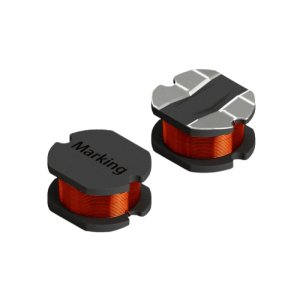
- Best for high-frequency SMPS
- Low core losses
- Sharp saturation behavior
Powdered Iron Inductors

- Soft saturation
- Good for high current
- Higher losses at high frequency
Step 7: Check DCR
Ploss = Irms² × DCR
Lower DCR improves efficiency and reduces heating.
Step 8: Verify Size and Temperature Rise
- Ensure PCB footprint fits
- Keep temperature rise below 40°C
- Check manufacturer thermal curves
Step 9: Check Self-Resonant Frequency
- SRF ≥ 5–10 × switching frequency
- Avoid capacitive behavior at high frequency
Quick Selection Checklist
-
✅ Correct inductance value
✅ Isat margin available
✅ Irms adequate
✅ Low DCR
✅ Proper core material
✅ Shielding as required
✅ Size fits PCB
✅ SRF sufficiently high
Common Design Mistakes
-
❌ Selecting by inductance only
❌ Ignoring saturation current
❌ Ignoring DCR losses
❌ Skipping thermal testing
Final Thoughts
Selecting the right inductor is a balance of electrical performance, thermal behavior, EMI, size, and cost. Proper calculation and lab validation ensure a reliable SMPS design.