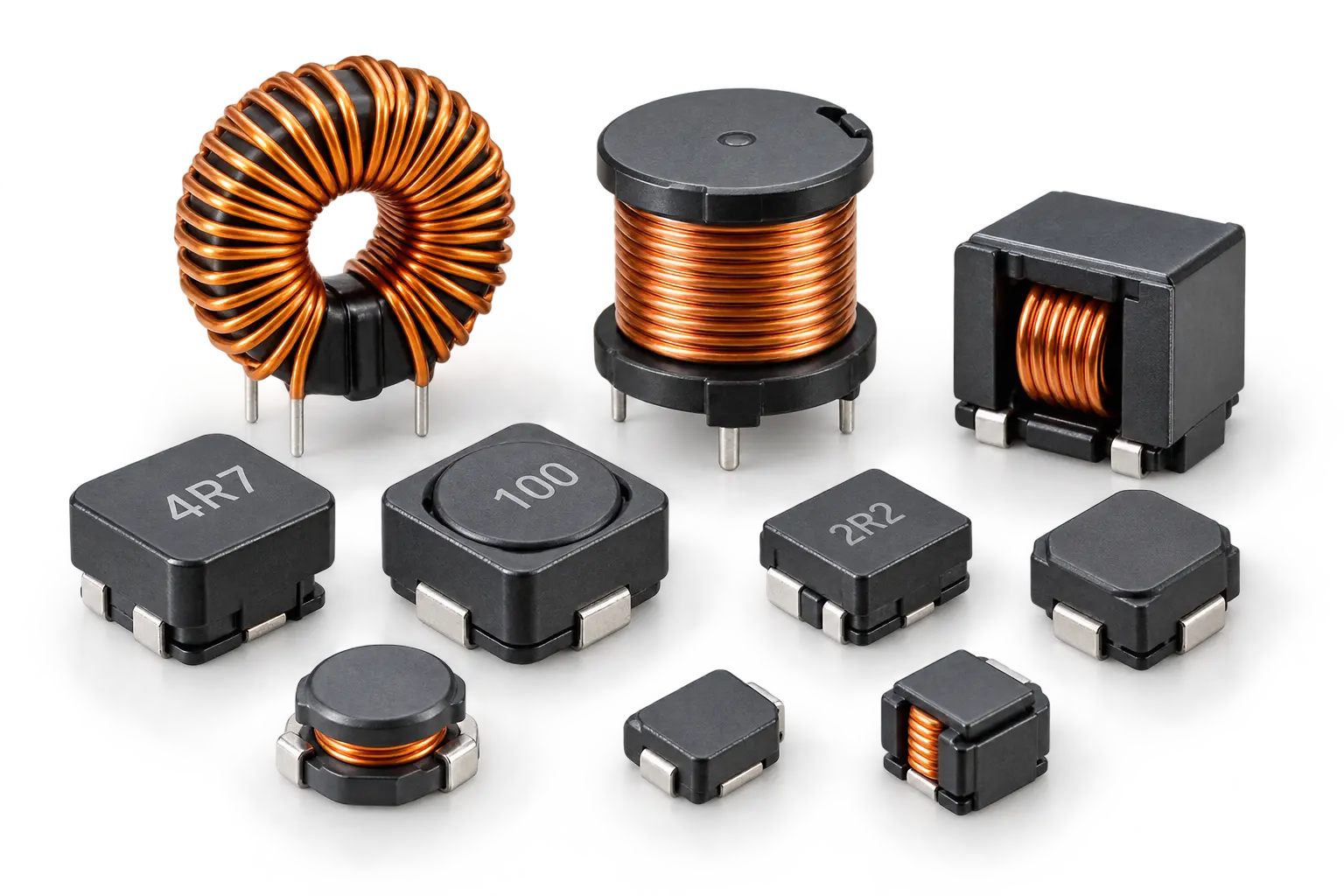
Power Inductor Manufacturer

Power Inductor Manufacturer & Supplier

Power inductors are essential components in modern electronic power systems, where they help store energy, regulate current, reduce ripple, and improve the efficiency of switching power supplies. Selecting the right power inductor manufacturer is therefore important for achieving reliable electrical performance, thermal stability, and consistent production quality.

Magno Teknik provides power inductor solutions for applications that require dependable energy storage, current handling, electromagnetic performance, and compact designs. Our product range supports applications across power conversion, automotive electronics, industrial equipment, telecommunications, consumer electronics, and other electronic systems.

Whether you need standard power inductors or components selected according to specific electrical and mechanical requirements, the right inductor design can help improve the overall performance and reliability of your power circuit.

What Is a Power Inductor?

A power inductor is a passive magnetic component designed to store electrical energy in a magnetic field when current flows through its winding. Unlike signal inductors used primarily for filtering or high-frequency signal processing, power inductors are designed to handle comparatively higher current and power levels.

Power inductors are commonly used in

Power Inductor Manufacturer & Supplier | SMD & Custom | Magno Teknik

Core Topologies, Regulators, and Converters

Fundamental circuit configurations and conversion technologies

  • DC-DC converters
  • Switching power supplies
  • Voltage regulators
  • Buck converters
  • Boost converters
  • Buck-boost converters

System-Level Applications and Markets

Complex electronic systems and target industry equipment

  • Battery management systems
  • Automotive power electronics
  • Industrial power supplies
  • Renewable energy equipment

Why Choose a Reliable Power Inductor Manufacturer?

The performance of a power inductor depends on more than its nominal inductance value. Engineers must consider current rating, saturation characteristics, DC resistance, operating frequency, temperature rise, physical size, and application conditions.

Working with an experienced power inductor manufacturer can help engineers and purchasing teams select components that meet the requirements of the complete power circuit.

Power Inductor Manufacturer & Supplier | SMD & Custom | Magno Teknik

Power Inductor Solutions

Reliable power inductors with consistent electrical and mechanical characteristics across production batches.
High-current power inductors designed for applications requiring reliable current handling and suitable saturation performance.
Options including SMD power inductors, shielded power inductors, drum core inductors, toroidal inductors, and high-current power inductors.
Components selected according to inductance, current rating, DCR, operating frequency, temperature, and PCB requirements.
Power inductors for DC-DC converters used in buck, boost, and buck-boost power-conversion applications.
Clear power inductor specifications and technical information to help engineers select suitable components.
Power inductor solutions for OEMs and electronics manufacturers requiring consistent components for production applications.

Power Inductors for DC-DC Converters

One of the most important applications of power inductors is DC-DC power conversion.

In a switching converter, the inductor temporarily stores energy and releases it as part of the converter’s switching cycle. Its characteristics directly influence current ripple, efficiency, transient response, and overall converter behavior.

Power inductors are used in common converter topologies such as:

  • Buck converters
  • Boost converters
  • Buck-boost converters

Key Power Inductor Specifications

Choosing a power inductor based only on its inductance value can result in poor circuit performance. Several specifications should be evaluated together, as power inductors are complex magnetic components operating under multi-variable stresses. Engineers must carefully analyze saturation currents, temperature ratings, core material behavior, and parasitic resistance parameters concurrently. A comprehensive multi-parameter evaluation ensures optimal conversion efficiency, long-term operational reliability, thermal stability, and low electromagnetic interference across dynamic load profiles.

Inductance

Inductance, measured in henries or commonly microhenries, indicates the component’s ability to oppose changes in current and store energy.

The required inductance depends on the circuit topology, switching frequency, input and output conditions, ripple-current requirements, and load.

Saturation Current

Saturation current indicates the current level at which the magnetic core begins to lose its ability to maintain the specified inductance.

A power inductor should have an appropriate saturation-current rating for the application’s peak current.

RMS Current

RMS current is associated with the thermal stress generated by current flowing through the winding. The component should be capable of handling the expected RMS current without excessive temperature rise.

DC Resistance

DC resistance, commonly referred to as DCR, represents the winding resistance of the inductor.

Lower DCR can help reduce resistive losses and improve power-conversion efficiency.

Operating Frequency

Inductor performance changes with frequency because both core and winding losses can increase at higher operating frequencies.

The selected component should therefore be evaluated at the actual operating frequency of the application

Temperature Rating

The inductor must operate reliably within the expected temperature range of the final product.

Ambient temperature, PCB conditions, current level, core losses, and copper losses should all be considered during thermal evaluation.

Size and Footprint

For modern electronic equipment, PCB space is often limited. The physical dimensions and mounting configuration of the inductor should match the available board area while still meeting electrical requirements.

How to Select the Right Power Inductor

Power Inductor Manufacturer & Supplier | SMD & Custom | Magno Teknik

Power Inductor Selection Workflow

Follow this step-by-step engineering roadmap to guarantee optimal magnetic component integration.

1

Determine the Required Inductance Baseline

Calculate or identify the precise inductance threshold required by the underlying power-conversion or filtering network.

2

Determine Maximum and RMS Current Electrical

Identify both the continuous RMS current load and the absolute maximum or transient peak current expected during standard operation.

3

Check Saturation Performance Core Limit

Ensure that the inductor's magnetic saturation roll-off characteristics are fully appropriate for peak current handling conditions.

4

Evaluate DCR (DC Resistance) Efficiency

Compare copper DC resistance properties because excessive internal resistance directly increases conduction losses and temperature rise.

5

Consider Operating Frequency Dynamics

Verify the component's core and AC performance behavior at the actual switching or high-frequency operating regime of the circuit.

6

Evaluate Thermal Conditions Environment

Factor in ambient operational temperature, PCB layout heat sinking, airflow dynamics, enclosure restrictions, and total allowable temperature rise.

7

Confirm Mechanical Compatibility Physical

Verify target package dimensions, structural mounting configuration, profile height, terminal arrangement, and overall PCB footprint clearances.

Applications of Power Inductors

Power inductors are used in a wide range of electronic systems where energy storage, current regulation, filtering, and efficient power conversion are required. Their electrical and thermal characteristics make them suitable for both compact electronic devices and high-current power systems.

Why Choose Magno Teknik as Your Power Inductor Manufacturer?

Magno Teknik focuses on magnetic and electronic components used in modern electronic systems.

Our power inductor solutions are intended for applications where engineers need a balance of electrical performance, compact design, current capability, and dependable operation.

When evaluating Magno Teknik for your power-inductor requirements, key considerations include:

  • Power inductor product options
  • Application-focused component selection
  • Support for power-management applications
  • Solutions for DC-DC conversion
  • Options for different current requirements
  • Support for OEM and electronic manufacturing requirements

The appropriate component should always be selected according to the electrical, mechanical, and environmental requirements of the final application.

Frequently Asked Questions About Power Inductors

A power inductor stores energy in a magnetic field and controls changes in current. It is widely used in power-conversion, filtering, and voltage-regulation circuits.
Power inductors are commonly used in DC-DC converters, switching power supplies, voltage regulators, battery systems, automotive electronics, industrial equipment, and other power-management applications.
Consider inductance, saturation current, RMS current, DCR, switching frequency, temperature rating, physical dimensions, and the electrical requirements of the application.
Saturation current is the current level at which the magnetic core begins to saturate and the effective inductance decreases significantly.
Lower DCR can reduce resistive losses in the winding, helping reduce power dissipation and improve efficiency.
SMD power inductors are designed for surface-mount PCB assembly, while through-hole inductors use leads that pass through PCB holes. The appropriate construction depends on the assembly process and application requirements.
Yes. Power inductors are fundamental components in many DC-DC converter topologies, including buck, boost, and buck-boost converters.
A shielded power inductor is designed to contain or reduce external magnetic flux, which can be beneficial in compact PCB designs and applications with electromagnetic-interference considerations.
Depending on the manufacturer's capabilities, power inductors can be designed or selected according to requirements such as inductance, current rating, dimensions, DCR, temperature range, and operating frequency.
A reliable manufacturer can help ensure consistent electrical characteristics, production quality, suitable component selection, and dependable supply for production applications.

Choose the Right Power Inductor for Your Application

The right power inductor can significantly influence the efficiency, thermal performance, current ripple, and reliability of a power-management circuit.

Whether you are developing a DC-DC converter, switching power supply, automotive electronic system, industrial controller, or another power-management application, the component should be selected according to the complete electrical and mechanical requirements of the design.

Magno Teknik provides power inductor solutions for a wide range of electronic applications. Explore the available power-inductor technologies and identify the component characteristics that best match your application requirements.