
Drum Core Inductor Specifications
The electrical and mechanical specifications of a drum core inductor help determine its suitability for power conversion, filtering, energy storage, and other electronic applications. The table below presents key specif\]ications for Magno Teknik’s MTDR Series THT drum core inductors, allowing engineers and procurement teams to compare inductance, current capability, DC resistance, and physical size.
| Specification | What It Means |
|---|---|
| Inductance | Energy storage capability |
| Inductance Tolerance | Permitted variation from nominal value |
| Rated Current | Recommended continuous operating current |
| Saturation Current | Current at which inductance starts decreasing |
| DC Resistance (DCR) | Winding resistance |
| Operating Frequency | Suitable frequency range |
| Temperature Rating | Maximum operating temperature |
| Self-Resonant Frequency | Frequency where parasitic effects become significant |
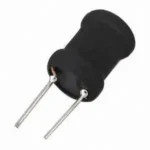
Inductance and Tolerance
The inductance value determines how much energy the power inductor can store and how effectively it controls current ripple. Selecting the correct value is important for stable operation in circuits such as DC-DC converters, voltage regulators, and power supplies.
Tolerance shows how much the actual inductance may vary from its specified value. A tighter tolerance provides more consistent circuit performance, while a wider tolerance may be suitable for less sensitive applications. Choosing the right inductance and tolerance helps maintain efficiency, current stability, and reliable power conversion.
Rated Current and Saturation Current
Rated current and saturation current are important drum core inductor specifications when selecting an inductor for power circuits. The drum core inductor current rating indicates the current the component can handle under specified temperature-rise conditions, while saturation current refers to the current level at which the inductance begins to decrease significantly.
| Specification | Meaning |
|---|---|
| Rated Current | Maximum recommended current for continuous operation while keeping the temperature rise within the specified limit. |
| Saturation Current | Current level at which the core begins to saturate and the inductance drops from its specified value. |
| Temperature Rise | Increase in component temperature caused by winding losses during operation. |
| Continuous Operation | The inductor should operate below its applicable current and temperature limits for reliable long-term performance. |
DC Resistance (DCR)
DC Resistance (DCR) is an important drum core inductor specification that represents the resistance of the inductor’s winding. A lower DCR generally helps reduce copper losses, minimize heat generation, and limit voltage drop during operation. When comparing drum core inductor parameters, engineers should consider DCR along with drum core inductor current rating and inductance to achieve better efficiency and reliable continuous operation.
Core Material and Construction
The core material and construction are important Drum Core Inductor Specifications because they influence inductance, current handling, losses, and mechanical reliability. A typical drum core inductor uses a magnetic core, copper winding, and terminals designed for stable electrical and mechanical performance
- Ferrite Core: Ferrite is commonly used as the magnetic material because of its suitable magnetic properties and relatively low core losses at high frequencies.
- Drum-Shaped Magnetic Core: The drum-shaped core provides the magnetic path around the winding and helps achieve the required drum core inductor inductance in a compact component.
- Copper Winding: The copper wire forms the coil and carries current. Its resistance directly affects DCR, power loss, and temperature rise.
- Terminals: Terminals provide electrical connection between the winding and the PCB and should support reliable soldering and current flow.
- Core Coating or Protection: Protective coatings can help improve mechanical strength, insulation, and resistance to environmental conditions.
Physical Dimensions and Mounting
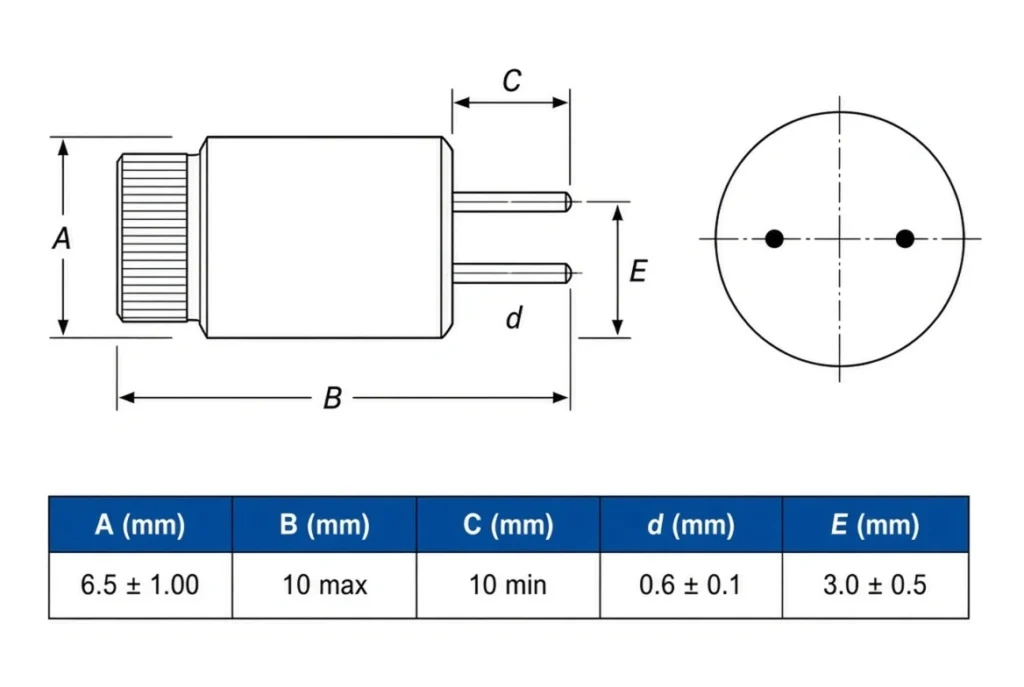
Drum core inductor dimensions determine how the component fits on a PCB and whether it meets the available board-space and mechanical requirements. Key dimensions include length, width, height, lead spacing, and terminal dimensions. Depending on the construction, drum core inductors can be supplied in surface-mount (SMD) or through-hole (THT) configurations.
Operating Temperatur
Drum core inductors are designed to operate reliably within a specified temperature range. Operating temperature depends on the core material, winding construction, insulation system, and rated current. Selecting an inductor with the appropriate temperature range helps maintain stable inductance and reliable performance under different operating conditions.
| Parameter | Description |
|---|---|
| Operating Temperature Range | Typical range such as −40°C to +125°C |
| Ambient Temperature | Temperature surrounding the inductor during operation |
| Temperature Rise | Increase in component temperature caused by power loss |
| Maximum Temperature | Maximum allowable operating temperature |
| Current Derating | Reduction in allowable current as temperature increases |
MTDR Series THT Drum Core Inductors
The MTDR Series THT Drum Core Inductors are designed for reliable energy storage, filtering, and power conversion applications. These through-hole inductors feature a drum-shaped magnetic core and copper winding, providing stable inductance and reliable current handling for electronic circuits.
The MTDR Series is available in different inductance and current ratings to meet various circuit requirements. Key specifications include inductance, inductance tolerance, rated current, saturation current, DC resistance (DCR), operating temperature, and physical dimensions.
| Parameter | MT68 Series |
|---|---|
| Series | MT68 |
| Mounting Type | THT / Through-Hole |
| Core Type | Drum Core |
| Inductance Range | 1.0 µH – 47,000 µH |
| Inductance Tolerance | ±10%, ±20% |
| Test Frequency | 0.0796–7.96 kHz, depending on part |
| Q (Minimum) | Depends on part number |
| Self-Resonant Frequency (SRF) | Depends on part number |
| DC Resistance (DCR) | Depends on part number |
| Rated Current (IDC) | Depends on part number |
| Dimensions | 6.5 × 10 × 10 mm approximately |
Applications of Drum Core Inductors
Drum core inductors are used in a wide range of electronic circuits for energy storage, current filtering, voltage regulation, and noise suppression. Their through-hole construction makes them suitable for power supply and industrial electronic designs where reliable PCB mounting and current handling are required.
DC-DC Converters
Drum core inductors are widely used in DC-DC converter circuits to store and release energy during switching operation. In buck, boost, and other switching converter designs, the inductor helps control current and reduce output ripple. When selecting a drum core inductor for a DC-DC converter, engineers should consider the required inductance, rated current, saturation current, DCR, switching frequency, and operating temperature to achieve reliable and efficient power conversion.
Power Supplies
Drum core inductors are commonly used in switching power supplies for energy storage, current filtering, and ripple reduction. The inductor works with other power components to provide a more stable current path and help minimize unwanted variations in the supply. The appropriate drum core inductor specifications depend on the input voltage, output current, switching frequency, and thermal conditions of the power supply. DCR and current ratings are particularly important for controlling power losses during continuous operation.
EMI and Noise Filtering
Drum core inductors can be used in filtering circuits to reduce unwanted electrical noise and current fluctuations in electronic systems. When combined with capacitors, they can form LC filtering networks that attenuate unwanted frequency components on power lines. For these applications, engineers need to consider inductance, impedance characteristics, operating frequency, current rating, and DCR.
LED Driver Circuits
Drum core inductors are used in switching LED driver circuits for energy storage and current regulation. In a switching-based LED driver, the inductor works with the switching device and other components to maintain controlled current through the LED load. The required inductance and current rating depend on the driver topology and operating conditions. DCR and thermal performance should also be considered because winding resistance contributes to power loss and temperature rise during continuous operation.
Battery-Powered Electronics
Drum core inductors are suitable for battery-powered electronic equipment that requires voltage conversion, regulation, or power filtering. They can be used in buck and boost converter circuits to convert battery voltage into the levels required by processors, sensors, communication modules, and other electronic components. When selecting an inductor for these applications, engineers should evaluate inductance, saturation current, rated current, DCR, physical size, and operating temperature to ensure stable performance throughout the expected battery and load conditions.
Industrial and Control Electronics
Drum core inductors are used in industrial control boards, automation equipment, instrumentation, and other electronic systems where reliable power filtering and conversion are required. Their through-hole construction provides secure PCB mounting for applications where mechanical stability is important. Depending on the circuit design, they can perform functions such as energy storage, current filtering, and power regulation. Selection should be based on the required drum core inductor specifications, including inductance, current capacity, DCR, operating frequency, temperature range, and component dimensions.
Drum Core Inductor vs Shielded Inductor
Drum core inductors and shielded inductors are both used for energy storage, filtering, and power conversion, but their construction and electrical characteristics can differ. Comparing key drum core inductor specifications with shielded inductor characteristics helps engineers select the right component for their application.
| Specification / Feature | Drum Core Inductor | Shielded Inductor |
|---|---|---|
| Core Construction | Drum-shaped magnetic core with winding around the core | Magnetic core surrounds or encloses the winding |
| Magnetic Shielding | Generally lower shielding | Higher magnetic shielding |
| EMI Performance | Suitable where moderate EMI control is acceptable | Better suited for applications requiring reduced magnetic interference |
| Inductance | Available across a wide range of values | Available across a wide range of values |
| Current Handling | Depends on core size, winding, and wire construction | Depends on core size, winding, and thermal design |
| Saturation Current | Important specification for high-current applications | Important specification for high-current applications |
| DCR | Affects winding losses and voltage drop | Affects winding losses and voltage drop |
| Mounting | Available in THT and other configurations | Commonly available in SMD configurations |
| PCB Space | Can be suitable for through-hole designs | Often preferred for compact PCB layouts |
| Typical Applications | Power supplies, DC-DC converters, filtering, energy storage | DC-DC converters, power supplies, EMI-sensitive circuits |
Drum Core Inductor Specifications & FAQ
1. What are the main drum core inductor specifications to consider?
The main drum core inductor specifications include inductance, inductance tolerance, rated current, saturation current, DC resistance (DCR), dimensions, and operating temperature. These specifications help determine whether an inductor is suitable for a particular power conversion or filtering application.
2. How do I select a drum core inductor?
Select a drum core inductor based on the required inductance, current rating, saturation current, DCR, operating temperature, mounting configuration, and available PCB space. The required specifications depend on the circuit and operating conditions.
3. What is the difference between rated current and saturation current?
Rated current generally relates to the allowable current under specified thermal conditions, while saturation current indicates the current level at which the inductance decreases due to magnetic-core saturation. Both specifications should be considered when selecting a drum core inductor for a power application.
4. Why is DCR important in drum core inductor specifications?
DC resistance (DCR) represents the winding resistance of the inductor. Lower DCR can help reduce copper losses and voltage drop, which can be important in high-current power circuits.
5. Are drum core inductors suitable for DC-DC converters?
Yes. Drum core inductors can be used in DC-DC converters, power supplies, filtering circuits, and energy-storage applications, depending on their electrical and mechanical specifications. For a detailed explanation of how power inductors operate in these circuits, see our [How Does a Power Inductor Work?] page.
6. What is inductance tolerance in a drum core inductor?
Inductance tolerance indicates how much the actual inductance value may vary from its nominal value. For example, a component specified at ±20% can have an inductance value within the stated tolerance range under the specified test conditions.
7. What does the physical dimension specification mean?
Physical dimensions define the component's length, width, height, lead spacing, and terminal dimensions, depending on the package. These measurements are important when designing the PCB footprint and ensuring proper THT mounting.
8. What is a THT drum core inductor?
A THT (Through-Hole Technology) drum core inductor has leads that pass through PCB holes and are soldered on the opposite side of the board. Magno Teknik identifies its MTDR Series as THT Drum Inductors in its application material.
9. What applications use drum core inductors?
Drum core inductors can be used in applications such as power supplies, DC-DC converters, LED drivers, filtering circuits, and energy-storage circuits. The appropriate component should be selected according to the required electrical and mechanical specifications.
10. How do drum core inductors compare with shielded inductors?
The main difference is their construction and magnetic shielding. A shielded inductor is designed to reduce magnetic radiation and interference, while drum core inductors can provide a practical solution for applications where their specific electrical and mounting characteristics meet the design requirements.